

Starting a blog is exciting, but choosing the right niche can feel overwhelming.
Maybe you’re interested in technology, travel, fitness, finance, cooking, or dozens of other topics. You might also be wondering whether you should choose something you’re passionate about or something that makes more money.
The truth is, your niche is one of the most important decisions you’ll make as a blogger. A good niche helps you attract the right audience, build authority, rank better in search engines, and create multiple income opportunities over time. On the other hand, choosing the wrong niche can make blogging feel frustrating and leave you running out of ideas after only a few posts.
The good news is that you don’t have to guess.
In this guide, you’ll learn exactly how to choose a blogging niche that fits your interests, has long-term growth potential, and gives you realistic opportunities to earn money. We’ll also cover common mistakes beginners make, examples of profitable niches, and a simple framework you can use to evaluate your own ideas before launching your blog.
If you’re completely new to blogging, we recommend reading our complete guide, How to Start a Blog in 2026: The Complete Beginner’s Guide, before choosing your niche. It walks you through the entire process, from selecting a domain name and web hosting to installing WordPress and publishing your first blog post.
Quick Answer
The best blogging niche is one that sits at the intersection of your interest, audience demand, and monetization potential. Choose a topic you enjoy writing about, make sure people are actively searching for it, and confirm that there are products, services, or other ways to generate income. A focused niche helps you build authority faster and creates a stronger foundation for long-term blogging success.
What Is a Blogging Niche?
A blogging niche is the main topic or subject your blog focuses on.
Instead of writing about everything, you create content around one specific area that attracts a particular audience.
Think of your niche as your blog’s identity.
For example:
- OrbitElf focuses on blogging, WordPress, web hosting, SEO, AI tools, and building websites.
- A fitness blog focuses on workouts, nutrition, and healthy living.
- A travel blog publishes destination guides, itineraries, and travel tips.
- A personal finance blog shares advice on budgeting, saving, and investing.
When readers visit your website, they should immediately understand what your blog is about and what kind of content they can expect.
A clear niche also helps search engines understand your website, making it easier for your articles to rank for relevant searches.
Niche vs Topic
Many beginners confuse a niche with a topic.
A niche is broad enough to build an entire website around, while a topic is a single article within that niche.
For example:
| Niche | Topics You Can Write About |
|---|---|
| Blogging | How to Start a Blog, Blogging Mistakes, Blog Name Ideas |
| WordPress | Installing WordPress, Themes, Plugins, Security |
| SEO | Keyword Research, On-Page SEO, Internal Linking |
| Fitness | Home Workouts, Weight Loss, Nutrition |
| Photography | Camera Guides, Editing Tips, Composition |
A healthy niche should provide enough ideas for dozens or even hundreds of helpful articles.
As a simple rule, ask yourself:
Can I realistically write 100 useful articles on this subject over the next few years?
If the answer is yes, you’re probably looking at a strong niche.
Why Learning How to Choose a Blogging Niche Matters
Some beginners believe they can choose any niche and change it later if it doesn’t work.
While that’s possible, starting with the right niche saves time, builds authority faster, and creates a much better experience for both readers and search engines.
Here are some of the biggest benefits of choosing the right niche.
It Helps You Build Topical Authority
Google wants to recommend websites that consistently publish helpful content around a particular subject.
For example, if your website publishes dozens of detailed articles about WordPress, search engines begin recognizing your site as a trusted resource for that topic.
On the other hand, if one week you write about smartphones, the next week about recipes, and the following week about gardening, it becomes much harder for Google to understand what your website specializes in.
A focused niche helps establish topical authority over time.
It Makes Content Planning Easier
Choosing the right niche is only the first step. Once you’ve made your decision, the next step is building your website and publishing your first article. If you haven’t done that yet, check out our complete guide on How to Start a Blog in 2026.
A well-chosen niche naturally leads to many related article ideas.
For example, if your niche is blogging, you can write about:
- Choosing a niche
- Registering a domain
- Web hosting
- WordPress
- SEO
- Content writing
- Affiliate marketing
- Email marketing
- Analytics
- Monetization
One topic often leads to another, making it much easier to stay consistent.
It Attracts the Right Audience
Visitors return to websites that consistently solve the problems they’re interested in.
Imagine someone searching for WordPress tutorials.
If they enjoy your article and discover that your website contains dozens of related WordPress and blogging guides, they’re much more likely to continue exploring your content and subscribe to your newsletter.
A focused niche helps you build a loyal audience instead of attracting one-time visitors.
It Improves Monetization Opportunities
Choosing a niche isn’t just about attracting readers. It’s also about creating opportunities to generate income in an honest and helpful way.
Many profitable niches have products and services that genuinely solve readers’ problems.
For example:
- Blogging websites can recommend web hosting, WordPress themes, plugins, and SEO tools.
- Photography blogs can recommend cameras, lenses, and editing software.
- Fitness blogs can recommend workout equipment, online coaching, and training programs.
When your recommendations align naturally with your readers’ needs, affiliate marketing feels helpful rather than promotional.
It Keeps You Motivated
Building a successful blog takes time.
There will be days when traffic is low or growth feels slow.
Choosing a niche you genuinely enjoy makes it much easier to stay motivated during those early months.
Passion alone won’t make a blog successful, but it will help you continue creating helpful content while your audience grows.
Can You Blog About Multiple Topics?
This is one of the most common questions beginners ask.
The short answer is:
Yes, but you should be strategic about it.
Many people want to create a website that covers everything they’re interested in.
For example:
- Technology
- Movies
- Cricket
- Cooking
- Travel
- Fitness
- Finance
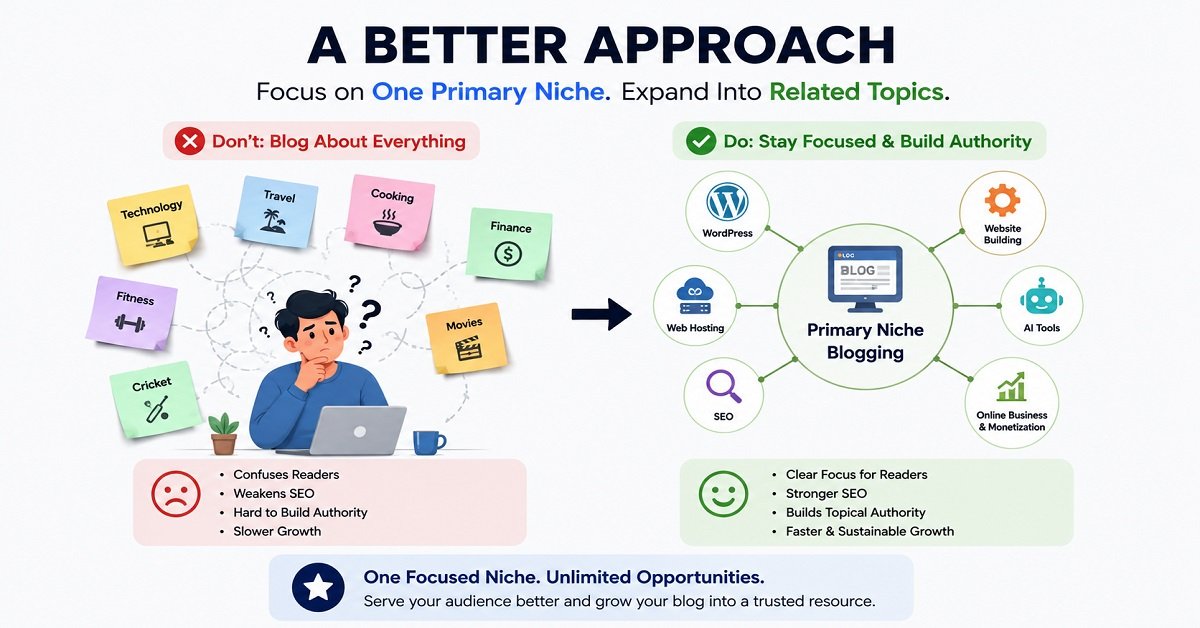
While this may sound exciting, it often creates a confusing experience for readers.
Imagine visiting a website to learn about WordPress, only to find the next article is about gardening and the one after that reviews smartphones.
Most readers won’t know what the website actually specializes in.
Search engines face the same problem.
Instead of becoming an authority on one subject, the site becomes average at many.
A Better Approach
Choose one primary niche and then expand into closely related topics.
OrbitElf is a good example.
Its main focus is helping people build and grow websites.
That naturally includes related topics such as:
- Blogging
- WordPress
- Web Hosting
- SEO
- AI Tools
- Website Building
- Online Business
Although these are different categories, they all serve the same audience and support the same goal.
This creates a strong, connected content ecosystem rather than a collection of unrelated articles.
OrbitElf Tip: If you’re unsure whether two topics belong together, ask yourself one simple question:
Would the same reader be interested in both?
If the answer is yes, they probably belong on the same website.
The 3-Part Formula for Choosing a Profitable Blogging Niche
Many beginners think the highest-paying niche is automatically the best niche.
That’s not true.
A niche that earns thousands of dollars for one blogger might fail completely for another.
The best blogging niche isn’t simply the one with the highest income potential. It’s the one that balances three important factors:
- Your interest
- Audience demand
- Profitability
Think of these as the three legs of a stool. Remove one, and the entire blogging strategy becomes unstable.
Let’s look at each factor in detail.
1. Choose a Topic You Can Enjoy Writing About
Your first question shouldn’t be:
“How much money can this niche make?”
Instead, ask yourself:
“Can I happily write about this topic for the next three to five years?”
Blogging isn’t about publishing five or ten articles.
Successful blogs often contain hundreds of helpful posts.
If you choose a topic only because someone says it’s profitable, you’ll probably lose motivation after a few weeks.
Ask Yourself These Questions
- Do I enjoy learning about this topic?
- Do friends or family ask me questions about it?
- Can I explain it in simple language?
- Would I still enjoy writing about it next year?
- Can I think of at least 30 article ideas right now?
If the answer to most of these questions is “yes,” you’ve found a promising niche.
Don’t Worry About Being an Expert
One common misconception is that you need years of experience before starting a blog.
That’s not always true.
Many successful bloggers simply document what they’re learning.
For example, if you’re learning WordPress, you can write beginner-friendly tutorials based on your own experiences. As your knowledge grows, your content naturally becomes more advanced.
Readers often appreciate learning from someone who recently solved the same problems they’re facing.
OrbitElf Tip: Passion gets you started, but curiosity keeps you going. Choose a niche you genuinely enjoy learning about, because blogging is a continuous learning journey.
2. Make Sure People Are Searching for the Topic
Even if you love a topic, your blog won’t grow if nobody is searching for information about it.
This doesn’t mean you need millions of monthly searches.
It simply means there should be a real audience looking for answers.
How to Check Demand
Fortunately, you don’t need expensive tools to validate your idea.
Here are some free methods.
Use Google Search
Start typing your topic into Google.
Notice the autocomplete suggestions.
These suggestions come from real searches people perform every day.
For example, if you type:
WordPressGoogle may suggest:
- WordPress tutorial
- WordPress themes
- WordPress plugins
- WordPress SEO
- WordPress hosting
These suggestions indicate genuine search interest.
Check “People Also Ask”
After searching Google, you’ll often see a section called People Also Ask.
This contains real questions users frequently search for.
Each question can become a future blog post.
For example:
- What is WordPress?
- Is WordPress free?
- How difficult is WordPress?
One simple search can generate dozens of content ideas.
Explore Google Trends
Google Trends helps you understand whether interest in a topic is increasing, stable, or declining over time.
This is especially useful for identifying evergreen topics.
For example:
- Blogging
- WordPress
- SEO
- Personal Finance
These continue attracting interest year after year.
On the other hand, a temporary viral trend may receive lots of attention today but disappear within a few months.
Look at Existing Blogs
Search for your niche and study the websites already publishing content.
Ask yourself:
- Are they actively publishing new articles?
- Do they have engaged readers?
- Are they updating old content?
- Do they appear to be successful?
Competition isn’t always a bad sign.
In many cases, it proves there’s demand.
If nobody is writing about a topic, there may simply not be enough audience interest.
3. Can You Make Money From This Niche?
If your goal is to build an online business, it’s important to choose a niche with realistic monetization opportunities.
That doesn’t mean every article should sell something.
Your first priority should always be helping readers.
However, it’s smart to understand how your niche can generate income in the future.
Affiliate Marketing
Many blogging niches naturally include products or services readers already need.
For example:
| Niche | Affiliate Opportunities |
|---|---|
| Blogging | Web hosting, WordPress themes, plugins |
| Photography | Cameras, lenses, editing software |
| Fitness | Equipment, workout programs |
| Technology | Laptops, software, accessories |
| Cooking | Kitchen appliances, recipe books |
When recommendations genuinely help readers, affiliate marketing becomes a valuable resource rather than an advertisement.
Display Advertising
Blogs with consistent traffic can earn through display advertisements.
Although advertising revenue usually depends on visitor numbers, it’s another income stream worth considering.
Digital Products
As your experience grows, you may create your own products.
Examples include:
- eBooks
- Templates
- Online courses
- Checklists
- Printable resources
- Premium guides
Unlike physical products, digital products don’t require inventory or shipping.
Services
Many bloggers eventually offer services related to their expertise.
Examples include:
- Freelance writing
- SEO consulting
- WordPress setup
- Website design
- Coaching
Your blog becomes a portfolio that demonstrates your knowledge and builds trust with potential clients.
The Sweet Spot
The ideal blogging niche sits where these three factors overlap.
- You enjoy writing about it.
- People actively search for it.
- There are genuine ways to monetize it.
When all three come together, you’ve found a strong foundation for a long-term blog.
Evergreen vs Trending Niches
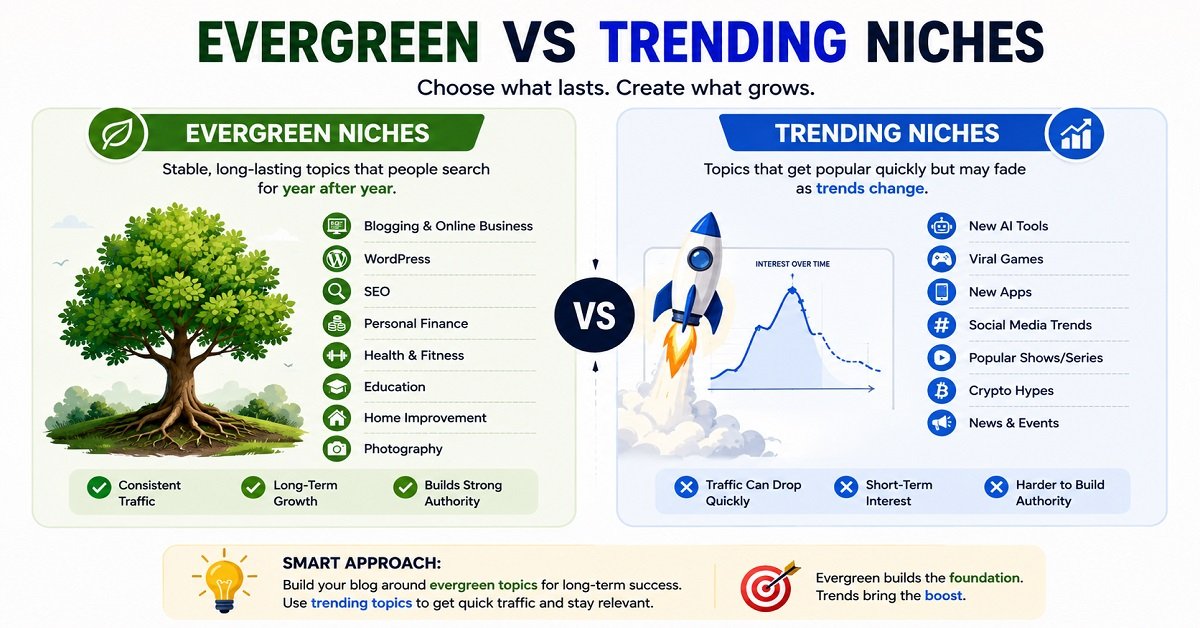
Another important decision is whether to build your blog around an evergreen niche or a trending topic.
Understanding the difference can save you from choosing a niche that quickly loses popularity.
What Is an Evergreen Niche?
An evergreen niche stays relevant for years.
People continue searching for the same information regardless of the season or current trends.
Examples include:
- Blogging
- WordPress
- SEO
- Personal Finance
- Health
- Gardening
- Education
- Home Improvement
These niches continue generating traffic because the underlying problems never disappear.
A beginner will still search “How to Start a Blog” next year, just as they do today.
What Is a Trending Niche?
A trending niche experiences rapid growth in popularity for a short period.
Examples might include:
- A newly released AI tool
- A viral mobile app
- A new social media platform
- A popular TV series
These topics can generate significant traffic quickly, but interest often declines as trends change.
Which One Should Beginners Choose?
For most beginners, an evergreen niche is the better long-term investment.
It allows you to build a library of articles that remain useful for years.
That doesn’t mean you should ignore trends completely.
A balanced strategy works best.
Build your website around an evergreen niche and occasionally publish articles about relevant trends within that niche.
For example, OrbitElf focuses on evergreen topics like blogging and WordPress while also covering emerging AI tools that help bloggers become more productive.
This approach gives you both long-term stability and opportunities to capture interest in new developments.
OrbitElf Tip: Trends can bring temporary traffic, but evergreen content builds lasting authority. Use trends to complement your niche, not define it.
Best Blogging Niches That Make Money
There isn’t a single “best” blogging niche that works for everyone.
The right niche depends on your interests, skills, audience, and long-term goals.
However, some niches consistently perform well because they solve ongoing problems, have strong search demand, and offer multiple ways to monetize.
Here are some of the most popular and profitable blogging niches.
1. Blogging and Online Business
This niche helps people start, grow, and monetize websites.
Popular article ideas include:
- How to Start a Blog
- Blogging Tips for Beginners
- Affiliate Marketing
- Email Marketing
- Content Writing
- Passive Income
Why It’s Profitable
Readers often need:
- Web hosting
- Premium WordPress themes
- SEO tools
- Email marketing platforms
- AI writing tools
This creates many natural affiliate opportunities while genuinely helping readers.
2. WordPress
Millions of websites use WordPress, and new users join every day.
That means there’s always demand for beginner-friendly tutorials.
Popular topics include:
- Installing WordPress
- Themes
- Plugins
- Security
- Speed Optimization
- Backups
WordPress is also closely connected with blogging, making it a great companion niche.
3. Search Engine Optimization (SEO)
Every website owner wants more visitors from Google.
SEO blogs teach readers how to improve their rankings and increase organic traffic.
Example topics:
- Keyword Research
- On-Page SEO
- Technical SEO
- Internal Linking
- Google Search Console
- Schema Markup
Since SEO changes over time, this niche provides endless opportunities for updated content.
4. Artificial Intelligence (AI)
AI is growing rapidly and continues to create new opportunities for bloggers.
Instead of writing only about trending AI news, focus on practical ways people can use AI.
Examples include:
- AI tools for bloggers
- AI writing assistants
- AI image generators
- AI productivity tools
- Prompt writing guides
Combining AI with blogging, WordPress, or SEO can make your content even more valuable.
5. Personal Finance
People are always looking for ways to:
- Save money
- Budget better
- Invest wisely
- Reduce debt
- Build wealth
Finance is highly competitive, but it also offers strong long-term potential if you have the knowledge and experience to create trustworthy content.
6. Health and Fitness
Health remains one of the largest evergreen niches.
Popular topics include:
- Home workouts
- Weight loss
- Nutrition
- Healthy recipes
- Mental wellness
If you write in this niche, make sure your content is accurate and responsible, especially when discussing medical or health-related topics.
7. Technology
Technology changes constantly, creating a steady stream of new content ideas.
Examples include:
- Laptop guides
- Smartphone comparisons
- Software tutorials
- Productivity apps
- Gadget reviews
Readers often research products before making purchases, making this niche suitable for affiliate marketing.
8. Education and Online Learning
Online learning continues to grow.
Readers search for:
- Study tips
- Career guidance
- Online courses
- Certifications
- Skill development
Helping people improve their knowledge creates long-term value.
9. Food and Cooking
Food blogs remain popular because people cook every day.
Ideas include:
- Recipes
- Meal planning
- Kitchen tips
- Healthy eating
- Cooking techniques
Visual content plays an important role in this niche.
10. Home and Lifestyle
This niche covers topics such as:
- Home improvement
- Organization
- Interior design
- Gardening
- DIY projects
These topics stay relevant year after year and attract readers looking for practical solutions.
Don’t Chase Profit Alone
Many beginners search online for:
“Which niche makes the most money?”
Unfortunately, that’s the wrong question.
Instead, ask:
Which niche can I consistently create helpful content about while solving real problems for readers?
The money usually follows the value you provide.
A moderately profitable niche that you enjoy writing about often performs better than a highly profitable niche that you lose interest in after a month.
How to Validate Your Niche Before Starting
Before registering your domain name or writing your first article, spend a little time validating your niche.
A few hours of research now can save months of frustration later.
Here’s a simple process you can follow.
Step 1: Brainstorm Article Ideas
Take a notebook or spreadsheet.
Write down at least 30 article ideas related to your niche.
For example, if your niche is WordPress, you might list:
- How to Install WordPress
- Best WordPress Themes
- WordPress Plugins
- WordPress Security
- Speed Optimization
- Gutenberg Tutorial
- WordPress Backups
- WordPress SEO
- WordPress Errors
- WordPress Maintenance
If you struggle to reach 30 ideas, your niche may be too narrow.
Step 2: Search Google
Search several of your ideas on Google.
Ask yourself:
- Are people already searching for these topics?
- Are there many related questions?
- Does Google suggest additional searches?
Healthy search activity indicates ongoing demand.
Step 3: Study Existing Websites
Visit websites in your niche.
Observe:
- What categories do they have?
- Which articles appear most popular?
- What questions do readers ask?
- Are they regularly updating content?
Remember, you’re looking for inspiration, not content to copy.
Step 4: Check Monetization Opportunities
Think about how readers might solve problems within your niche.
Examples include:
- Purchasing software
- Buying online courses
- Using web hosting
- Downloading templates
- Hiring professional services
You don’t need to sell immediately.
Simply make sure opportunities exist for the future.
Step 5: Imagine Writing 100 Articles
Finally, ask yourself one important question:
Can I realistically publish 100 helpful articles about this topic over the next few years?
If the answer is yes, you’ve probably chosen a strong niche.
If the answer is no, consider narrowing or expanding your focus.
Common Mistakes When Learning How to Choose a Blogging Niche
Almost every blogger makes mistakes in the beginning.
Fortunately, most of them can be avoided.
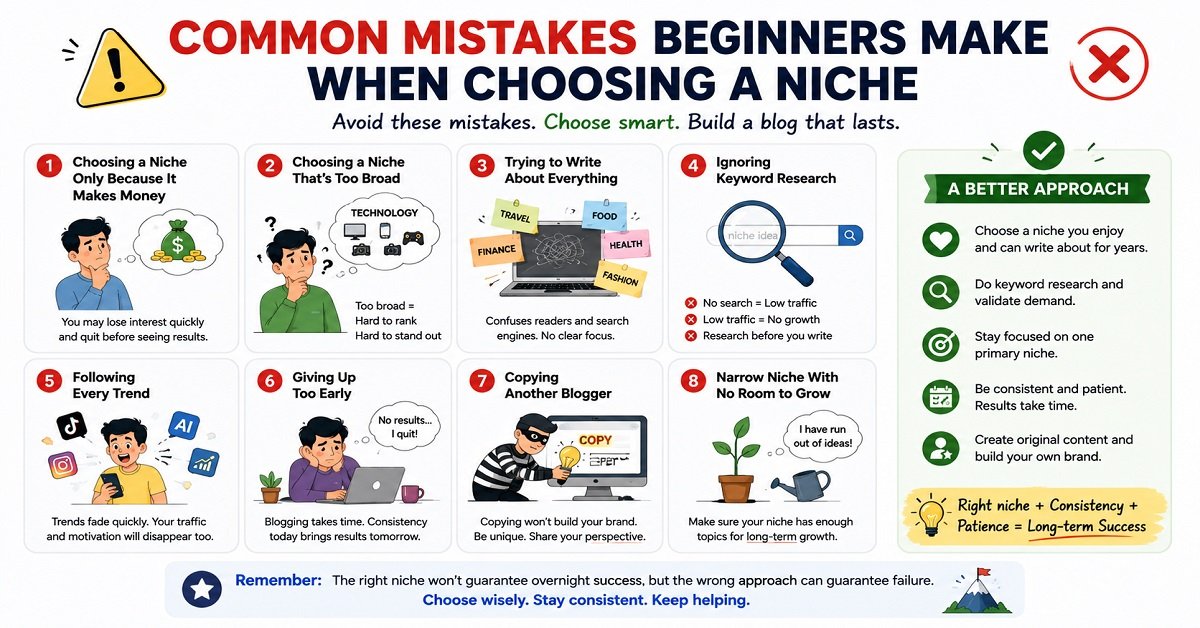
Choosing a Niche Only Because It Makes Money
Money is important.
But if you dislike the topic, staying consistent becomes difficult.
Interest keeps you publishing while your blog grows.
Choosing a Niche That’s Too Broad
A website about “technology” is very broad.
A website about “WordPress for beginners” is much more focused.
Narrowing your niche helps readers immediately understand your expertise.
Trying to Write About Everything
Covering unrelated topics often confuses both readers and search engines.
Focus on one primary audience.
Expand naturally over time.
Ignoring Keyword Research
Some bloggers write dozens of articles without checking whether anyone is searching for those topics.
Basic keyword research helps you understand what your audience actually wants to learn.
Following Every Trend
Trending topics can bring temporary traffic.
However, relying only on trends often leads to inconsistent growth.
Evergreen content should always be the foundation of your blog.
Giving Up Too Early
Many bloggers switch niches after only a few months because they don’t see immediate results.
Building authority takes time.
Stay consistent before deciding your niche isn’t working.
Copying Another Blogger
It’s perfectly fine to learn from successful websites.
It’s not okay to copy their content, branding, or strategy exactly.
Your own experiences and perspective are what make your blog unique.
OrbitElf Tip: Instead of asking, “What niche makes the most money?” ask, “Which niche allows me to consistently help people while building expertise?” That mindset leads to better content, stronger reader trust, and more sustainable growth.
How to Choose a Blogging Niche: Final Checklist
By now, you should have a few niche ideas in mind.
Before making your final decision, use this simple checklist to evaluate each one.
The more questions you answer with “Yes,” the stronger your niche is likely to be.
Interest
- □ Do I genuinely enjoy learning about this topic?
- □ Can I imagine writing about it for the next three to five years?
- □ Would I still enjoy creating content even before earning money?
Audience Demand
- □ Are people actively searching for this topic?
- □ Can I find plenty of article ideas?
- □ Does Google show related searches and “People Also Ask” questions?
Monetization
- □ Are there products or services I can honestly recommend?
- □ Could I eventually create digital products or offer services?
- □ Are there multiple ways to earn income from this niche?
Long-Term Growth
- □ Can I publish at least 100 helpful articles?
- □ Is the niche likely to remain relevant for years?
- □ Can I continue learning and improving my knowledge?
If you answered “Yes” to most of these questions, you’ve likely found a niche with strong long-term potential.
Pros and Cons of Choosing a Focused Blogging Niche
Like every important decision, choosing a niche has both advantages and challenges.
Understanding both will help you set realistic expectations.
Pros
Easier Content Planning
A focused niche gives you a clear direction.
Instead of wondering what to write next, you’ll naturally discover dozens of related topics.
Better SEO
Publishing related articles helps search engines understand your website’s expertise.
This can improve your topical authority over time.
Builds Reader Trust
Visitors know exactly what your website offers.
When every article solves similar problems, readers are more likely to return and explore additional content.
More Monetization Opportunities
A focused audience makes it easier to recommend relevant products, services, and tools.
This creates a better experience for readers while opening multiple income opportunities.
Stronger Brand Identity
People remember websites that clearly specialize in something.
A focused niche helps your blog become known for a particular subject.
Cons
Requires Research
Choosing the right niche takes time.
It’s worth spending a few extra hours researching before launching your blog.
Competition Can Be High
Many profitable niches already have established websites.
Don’t let that discourage you.
There’s still room for new bloggers who create genuinely helpful content and consistently provide value.
Narrow Niches May Feel Limiting at First
Some beginners worry they’ll run out of ideas.
In reality, most focused niches contain hundreds of potential article topics once you begin researching them.
Frequently Asked Questions
Which blogging niche makes the most money?
There isn’t a single niche that’s best for everyone.
Popular niches like blogging, WordPress, SEO, personal finance, technology, and health offer strong earning potential because they combine high demand with multiple monetization opportunities.
However, your long-term success depends more on creating helpful content consistently than choosing the highest-paying niche.
Can I change my blogging niche later?
Yes.
Many bloggers refine or expand their niche as they gain experience.
However, changing your niche too often can confuse readers and slow your website’s growth.
That’s why it’s worth spending time choosing a niche carefully before you begin.
Is it okay to have multiple niches?
Yes, provided the topics are closely related and serve the same audience.
For example, OrbitElf covers blogging, WordPress, web hosting, SEO, AI tools, and online business because they naturally support one another.
Avoid combining completely unrelated topics such as fitness, travel, cooking, and technology on the same website.
How narrow should my niche be?
Your niche should be focused enough to build authority but broad enough to support long-term growth.
A good rule is to choose a niche that can realistically provide at least 100 useful article ideas.
Should I choose a low-competition niche?
Low competition can make it easier to gain visibility, but demand is equally important.
A niche with no competition may simply have very little audience interest.
Instead of avoiding competition entirely, look for opportunities to create more helpful, beginner-friendly content than what’s already available.
How do I know if people are interested in my niche?
You can check demand using free tools such as:
Google Search
Google Trends
Google Keyword Planner
Google “People Also Ask”
These tools help you discover what people are searching for and whether interest in a topic is growing over time.
Do I need to be an expert before starting a blog?
No.
Many successful bloggers begin by documenting what they’re learning.
As long as you’re honest, continue learning, and create accurate, helpful content, you can grow alongside your audience.
How many articles should I publish before deciding whether my niche is working?
Avoid judging your niche after only a few articles.
A better approach is to publish at least 30 to 50 high-quality articles consistently before evaluating your results.
Blogging is a long-term investment, and meaningful growth usually takes time.
Final Thoughts
Choosing a blogging niche isn’t about finding the “perfect” idea.
It’s about choosing a topic you genuinely enjoy, one that helps real people solve real problems and gives you enough room to grow over the coming years.
Don’t let fear of making the wrong decision stop you from getting started.
Every successful blogger began with uncertainty.
What made the difference wasn’t finding a magical niche.
It was taking action, publishing consistently, learning from experience, and improving over time.
Choose a niche that excites you, validates your idea with research, and commit to creating content that genuinely helps your readers.
Remember, your niche doesn’t have to be perfect on day one.
It simply needs to be good enough for you to start.
Your first article won’t be your best.
Your first month won’t be your most successful.
But every helpful article you publish moves you one step closer to building a website that readers trust and return to.
So stop overthinking, choose your niche, and begin creating.
Your future audience is already searching for the answers you can provide.